reconcile faster
protect benefit spend
Tabulera’s Workday integration helps teams find and resolve benefits billing variances faster
Catch billing errors. Speed up monthly audits. Eliminate write-offs.
How Workday Teams Typically Reconcile Benefit Invoices
Since carrier bills live outside the Workday environment, teams export enrollment and payroll reports and combine them with carrier invoices in Excel. This spreadsheet layer is used to connect Workday data with billing data so totals can be reviewed and explained.
The work is typically maintained by one person and handled alongside other responsibilities, rather than through a dedicated, visible workflow.
Why reconciliation breaks down
Manual data preparation
Each cycle starts with exporting reports, cleaning files, and aligning formats. Data preparation alone can take days before review begins.
Misaligned timing
Carrier billing cycles and payroll frequencies rarely line up, so totals do not naturally match.

No shared identifier
Carrier bills do not reference Workday employee or coverage IDs. Teams rely on names, plan labels, and assumptions to infer matches across systems.
Custom logic everywhere
Spreadsheets rely on formulas, assumptions, and manual adjustments to make the data usable.
Streamline Benefits Reconciliation with Workday Integration
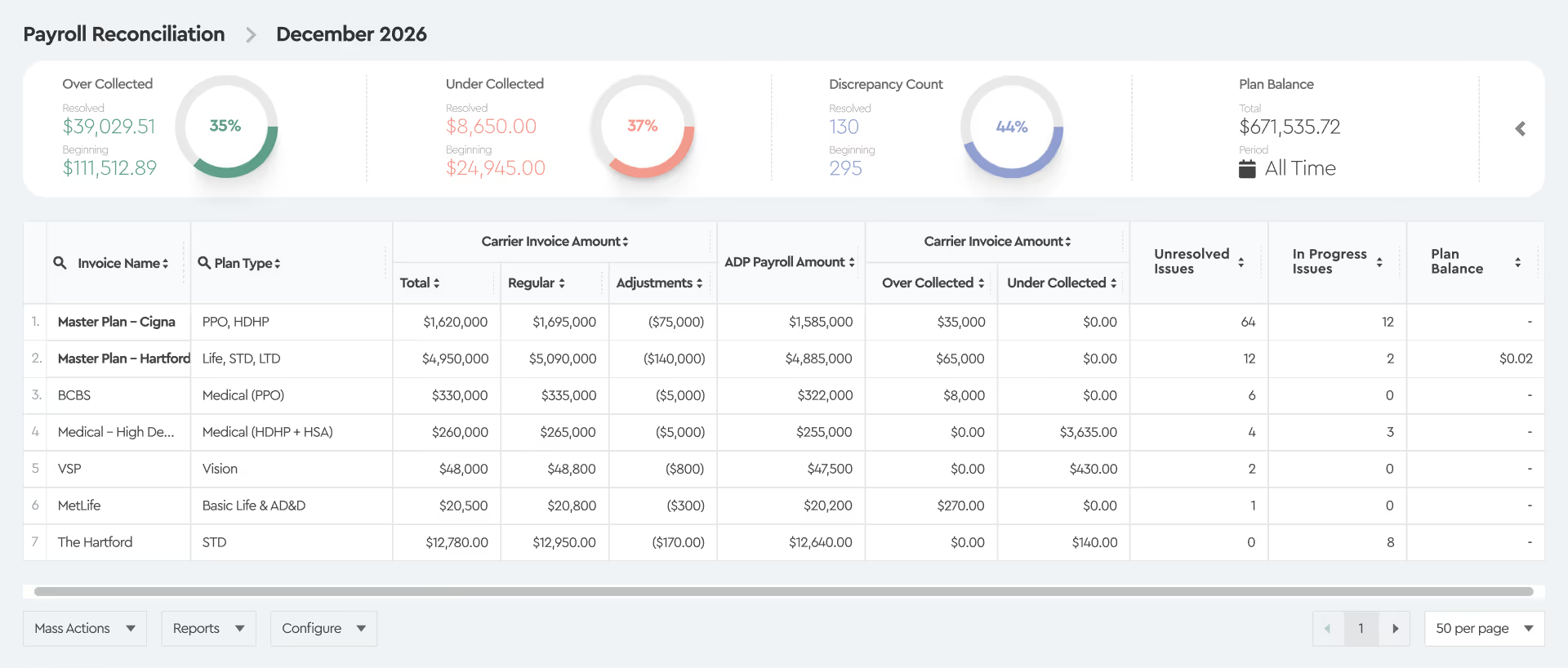
Tabulera helps teams focus on employee-level variances instead of full invoice reviews.
Instant start
Workday automated reconciliation replaces hours spent stitching together reports and carrier invoices in Excel.
-
Workday data
automatically synced -
Simply drop in your
carrier invoices -
Most records
matched automatically
- Enrollment
- Payroll
- COBRA
Noise removed
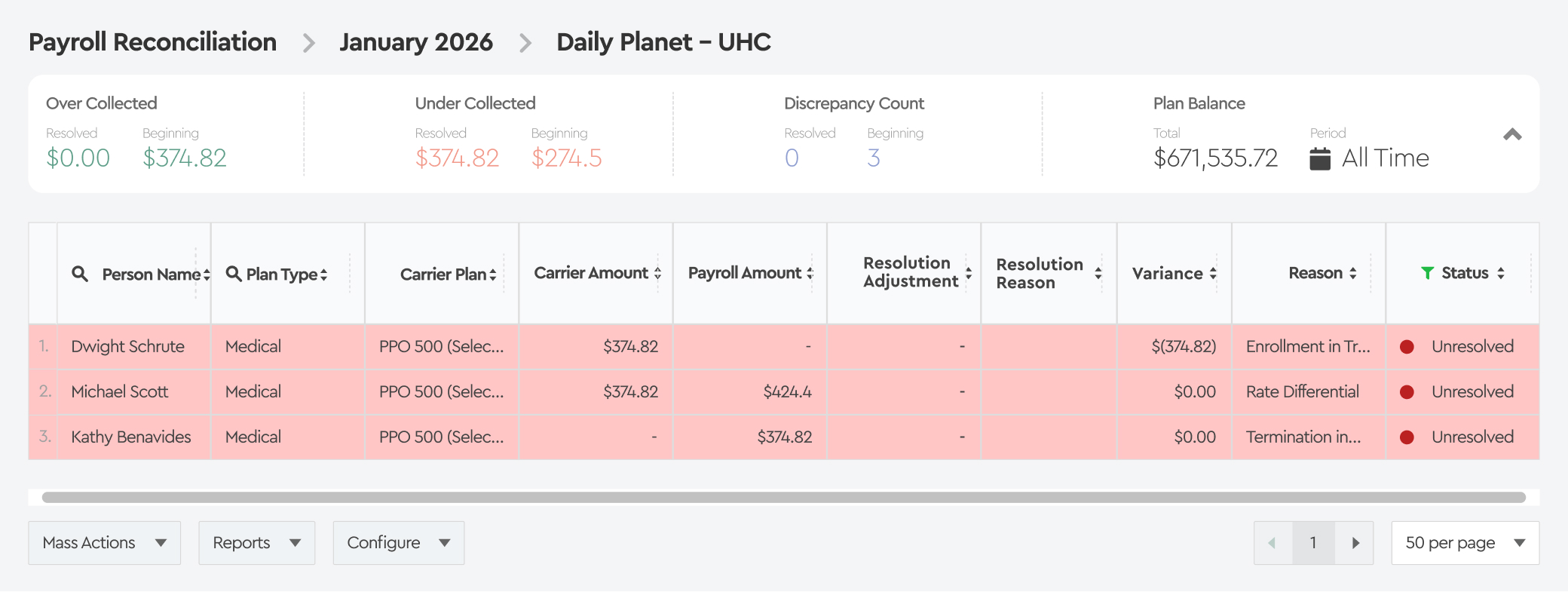
No more reviewing employees with no issues. Only records with variances remain.
- Clean records filtered out automatically
- Focus only on employees with issues
- Review time stays consistent each month
Employees auto resolved
Explain Faster
No more digging through historical financial data to explain variances.
- All employee charges and adjustments connected
- Full variance history available in one view
- Answers available without reopening prior periods
Faster than Excel
How Tabulera’s Workday Integration Works
Tabulera introduces a structured workflow that is easy to learn, easy to manage, and consistent month to month.
Connect Workday via Secure API
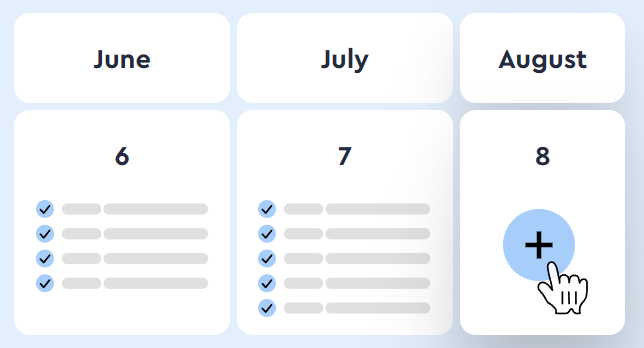
Pick reconciliation period
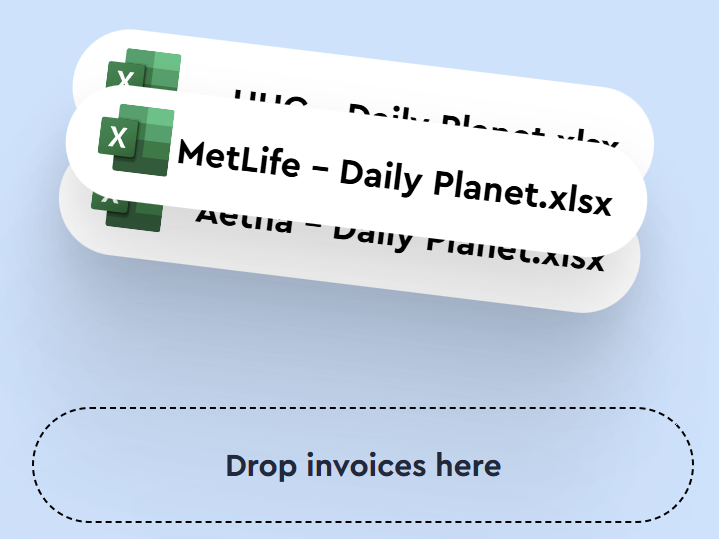
Drop in your carrier bills
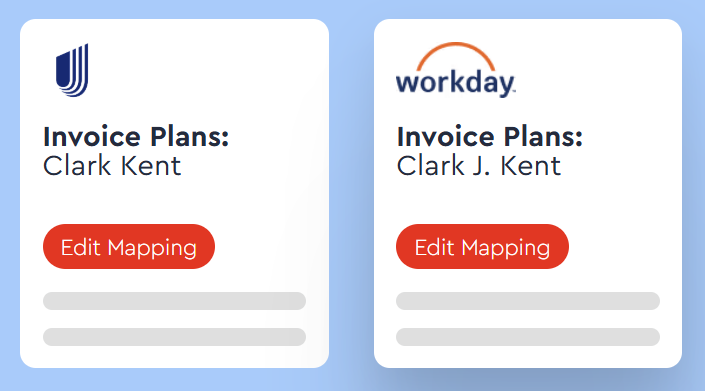
Map invoice plans to Workday
match automatically
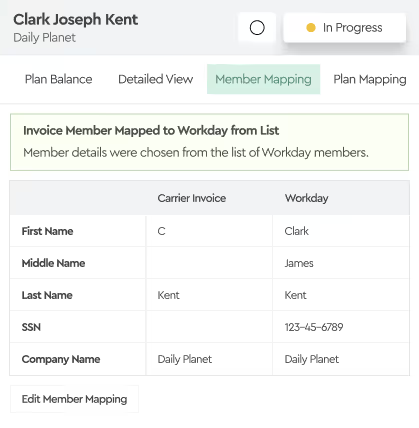
Replaces spreadsheet logic and manual joins. Most records are matched automatically, and when clarification is needed, the system prompts for quick input and retains the mapping.
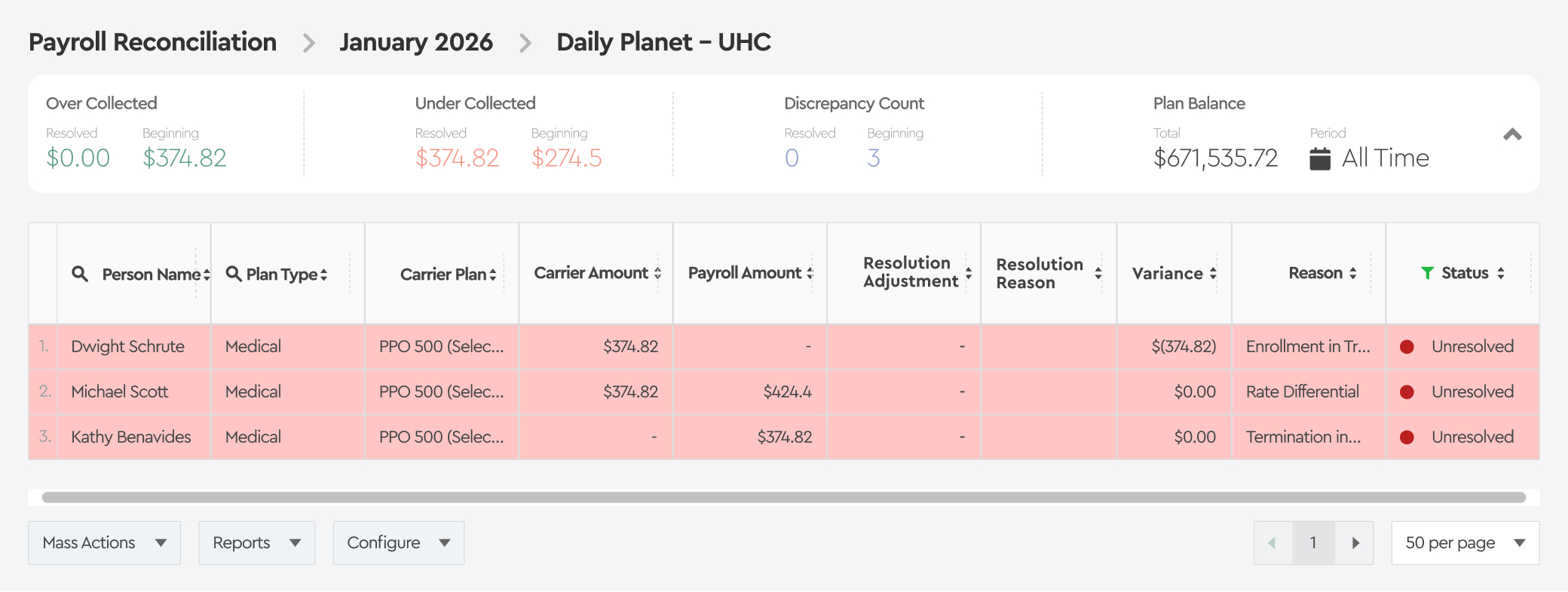
Automatically Find Variances
Employees without issues are filtered out, so review starts directly with variances that need attention. Variances are automatically categorized, making it easy to spot patterns and recurring issues.
Resolve variances
Billing dispute
Notify carriers, request refunds, and track follow-up until resolved
Data correction
Update enrollment or payroll data directly in Workday and keep records aligned
Pending review
Add notes, document status, and wait for carrier or payroll adjustments
Control write-offs
Close out older or immaterial balances based on company policy
Maintain Audit Trail
Generate Reports
What Workday Automated Reconciliation means for Stakeholders?
Benefits reconciliation impacts multiple stakeholders – from Finance to HR – and automation brings measurable gains to each group.
For Finance Teams
- Accurate monthly benefits spend
- Fewer surprise write-offs
- Audit-ready reports to support financial close
For Benefits Admins
- No more manual Excel audits
- Variances explained with reasons and resolution paths
- 75% faster month-end reconciliation
For HR Leaders
- Confidence in accurate coverage
- Stronger controls without adding headcount
- Ability to scale benefits operations as the company grows
Case Study: $136K in Premium Write-Offs Saved by Q3
A large employer with 7,000 benefit-eligible employees struggled with premium leakage, averaging $136,944 in write-offs in Q1 alone. Manual reconciliation caused delays, errors, and unnecessary costs.
By implementing Tabulera’s Benefits Reconciliation Module, the client automated reconciliation, eliminated manual spreadsheets, and cut premium write-offs dramatically over the next 8 quarters.
Saved by q3
less Write-offs
Works with List and Self-Bills
Each billing method has its own pros and cons, but all of them need to be reconciled to ensure billing accuracy.
List-Billed Plans
Carrier list bills often include inaccuracies – such as terminated employees still being billed, missing dependents, or miscalculated premiums.
Without reconciliation, these errors flow straight into overpayments or write-offs.
Self-Billed Plans
Self-billing avoids timing differences but leaves employers uncertain about which rates carriers may apply or when increases will take effect.
Errors can also arise from the complexity of eligibility rules and wash rule algorithms.
Mixed Models
Many employers run a combination of self-billed and list-billed plans.
This adds another layer of complexity by having two different reconciliation workflows to manage.
FAQ
What is Tabulera’s Workday integration?
Tabulera’s Workday integration uses a secure API connection to retrieve enrollment and payroll data directly from Workday. Without the integration, teams must regularly generate and upload enrollment and payroll reports manually to reconcile carrier invoices.
Integrate your Workday instance with Tabulera.
Move reconciliation out of spreadsheets, eliminate manual work, and prevent costly errors.